
All Types of Cars Explained: Names, Examples, Uses, and Differences
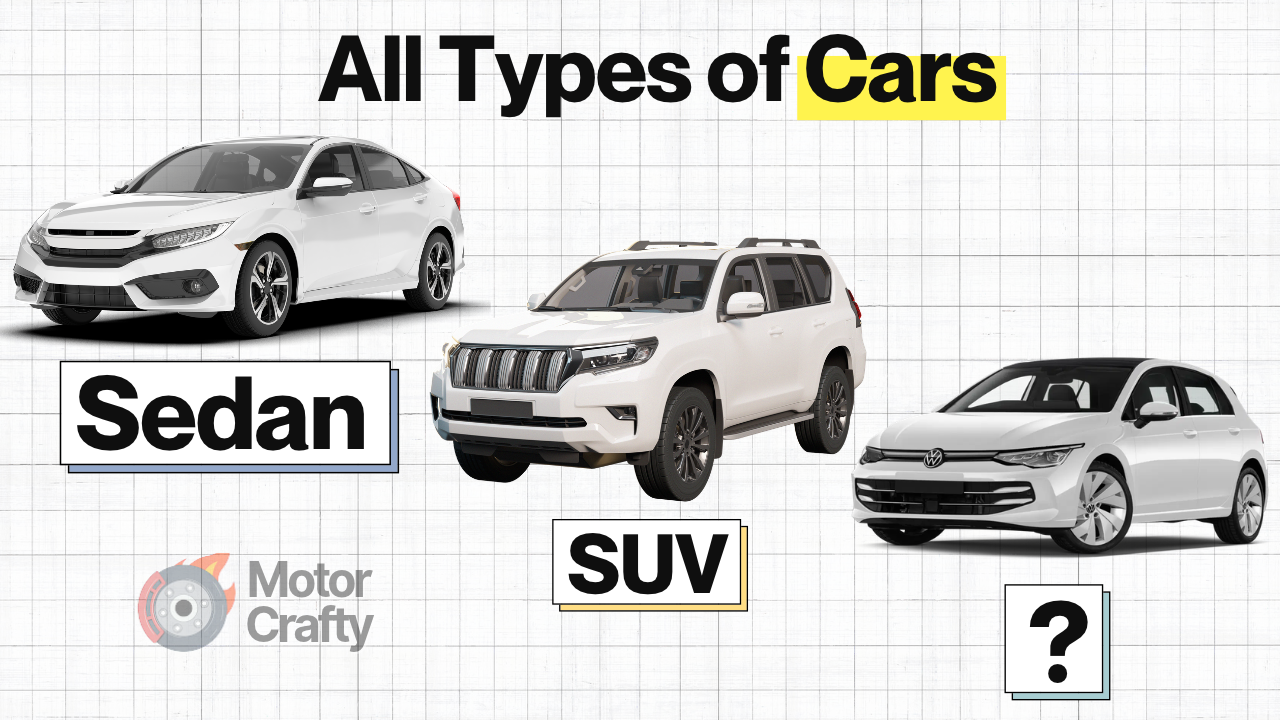
Cars come in many different shapes and sizes. Some are small enough to navigate crowded city streets easily, while others provide plenty of room for families, carry heavy loads, or deliver high-performance driving experiences.
You’ve probably heard terms like hatchback, sedan, SUV, coupe, and convertible. But what exactly makes these vehicles different? And which type is best suited for everyday commuting, family trips, off-road adventures, or sports driving?
The answer depends on the vehicle’s body style, purpose, size, and design.
In this guide, we’ll explore the major types of cars, including their defining features, common uses, advantages, limitations, and real-world examples.
1. Hatchback
A hatchback is a passenger car with a rear door that opens upward to provide access to the cargo area. Unlike a traditional sedan, its luggage compartment is connected to the passenger cabin.
Most hatchbacks have two or four side doors, along with the rear hatch. Many also feature folding rear seats, making it easier to carry larger objects when necessary.
Their compact dimensions make hatchbacks convenient for crowded streets and tight parking spaces. Many are also relatively economical to run, although fuel efficiency depends on the specific engine and model.
Common uses:
- Daily commuting and city driving
- Shopping and running errands
- Carrying luggage and small household items
- Transportation for individuals and small families
Examples: Toyota Yaris, Suzuki Swift, Volkswagen Golf, and Honda Jazz.
Main advantage: Practical cargo access in a compact vehicle.
Main limitation: Less passenger and cargo space than many larger vehicles.
2. Sedan
A sedan is a passenger car that typically has four doors, a fixed roof, and a separate trunk. Its traditional three-box design separates the engine compartment, passenger cabin, and luggage compartment.
Sedans come in many sizes, from affordable compact models to luxurious executive cars. They often provide comfortable seating, a relatively low driving position, and a smooth highway experience.
The separate trunk also keeps luggage out of the main passenger compartment.
Common uses:
- Everyday transportation
- Commuting to work or school
- Family travel
- Business and chauffeur services
Examples: Toyota Corolla, Honda Civic Sedan, Hyundai Elantra, and BMW 3 Series.
Main advantage: A balanced combination of comfort, practicality, and everyday usability.
Main limitation: The trunk opening can make loading bulky objects more difficult than in a hatchback or wagon.
3. SUV (Sport Utility Vehicle)
An SUV is a vehicle characterized by its taller body, elevated seating position, and generally greater ground clearance than a conventional passenger car.
SUVs are available in several sizes. Smaller models may offer two rows of seats, while larger models can accommodate three rows and substantial luggage.
Their capabilities vary considerably. Some SUVs are designed mainly for comfortable driving on paved roads, while others include four-wheel drive, specialized suspension, and other equipment for off-road travel.
Common uses:
- Family transportation
- Long road trips
- Driving on uneven or poorly maintained roads
- Carrying passengers and luggage
- Towing, where the model is equipped for it
Examples: Toyota Fortuner, Ford Everest, Toyota Land Cruiser, and Range Rover.
Main advantage: A high seating position and versatile passenger and cargo space.
Main limitation: Larger models can consume more fuel and be harder to park than smaller cars.
4. Crossover (CUV)
A crossover, or Crossover Utility Vehicle (CUV), combines SUV-like styling and practicality with a car-based structure. Most use unibody construction, in which the body and structural frame are integrated.
Crossovers usually emphasize on-road comfort, manageable dimensions, and everyday versatility. Many provide raised seating and useful cargo space without the size of a full-size SUV.
Although crossovers and SUVs overlap, traditional body-on-frame SUVs are more commonly associated with demanding towing and off-road applications. Actual capabilities depend on the vehicle rather than its name alone.
Common uses:
- Daily commuting
- Family transportation
- Weekend trips
- Driving on ordinary roads and occasional rough surfaces
Examples: Honda CR-V, Toyota RAV4, Nissan X-Trail, and Kia Sportage.
Main advantage: A practical mix of comfort, space, and SUV-style utility.
Main limitation: Most crossovers are not designed for the most demanding off-road conditions.
5. Coupe
A coupe traditionally refers to a two-door passenger car with a fixed roof. Coupes often have a sloping roofline and a sportier appearance than conventional sedans.
Some models are built around performance, while others focus on luxury or distinctive styling. A coupe may have rear seats, but access and passenger space can be more limited than in a comparable sedan.
The term is also used by some manufacturers for four-door vehicles with coupe-like rooflines.
Common uses:
- Personal transportation
- Weekend driving
- Enjoying sporty styling
- Performance-oriented driving, depending on the model
Examples: Ford Mustang Coupe, BMW 4 Series Coupe, Audi A5 Coupe, and Mercedes-Benz C-Class Coupe.
Main advantage: Distinctive styling and, in many models, an engaging driving experience.
Main limitation: Rear-seat access and practicality may be reduced.
6. Convertible
A convertible is a car whose roof can be folded, retracted, or removed to open the cabin to the outdoors.
Soft-top convertibles typically use a fabric roof, while hard-top versions use rigid panels. Some roofs fold automatically into a storage compartment.
Convertibles range from small two-seat roadsters to luxury cars with more passenger space. Their main appeal is the open-air experience, rather than maximum practicality.
Common uses:
- Scenic drives
- Leisure and weekend driving
- Touring in suitable weather
- Enjoying a sporty or luxury vehicle
Examples: Mazda MX-5 Miata, BMW Z4, Porsche 911 Cabriolet, and Ford Mustang Convertible.
Main advantage: The option of driving with the roof open.
Main limitation: Roof mechanisms can add cost and weight, and storage space may be limited.
7. Pickup Truck
A pickup truck has a passenger cabin at the front and an open cargo bed at the rear. The bed is designed to carry tools, construction materials, agricultural supplies, and other bulky loads.
Pickups range from compact utility vehicles to large trucks with powerful engines and substantial towing capabilities.
Some models are basic work vehicles, while others offer comfortable interiors and features similar to those found in passenger SUVs.
Common uses:
- Construction and agricultural work
- Transporting tools and materials
- Carrying outdoor and recreational equipment
- Driving on rough roads
- Towing trailers within the vehicle’s rated limits
Examples: Toyota Hilux, Ford Ranger, Isuzu D-Max, and Nissan Navara.
Main advantage: A dedicated cargo bed that can carry bulky or dirty items.
Main limitation: The open bed may need a cover to protect cargo, and the vehicle can be less convenient in crowded urban areas.
8. Van and Minivan (MPV)
Vans are spacious vehicles designed to transport passengers or cargo. Passenger vans typically have multiple rows of seating, while cargo vans feature enclosed loading areas.
A minivan, often called a multi-purpose vehicle (MPV) in many markets, focuses on passenger comfort and flexible interior space. Sliding doors, a tall cabin, and configurable seating make many minivans convenient for families.
Not all vans and minivans have the same passenger capacity. Smaller models may seat five to eight people, while larger passenger vans can accommodate more.
Common uses:
- Large-family transportation
- Airport shuttles and group travel
- Hotel and business transport
- Deliveries and commercial operations, for cargo-oriented vans
Examples: Honda Odyssey, Kia Carnival, Toyota HiAce, and Mercedes-Benz V-Class.
Main advantage: Spacious interiors and flexible passenger or cargo arrangements.
Main limitation: Larger vans can be cumbersome to maneuver and park.
9. Station Wagon (Estate Car)
A station wagon, also called an estate car, resembles a sedan with an extended roof and a large rear hatch. The extended rear section provides additional cargo space while retaining a relatively low passenger-car profile.
Many wagons have folding rear seats, allowing the luggage area to expand for large suitcases, sports equipment, or other bulky items.
Compared with many SUVs, wagons offer a lower loading height and a lower seating position. Whether they are more economical or comfortable depends on the particular models being compared.
Common uses:
- Family road trips
- Carrying luggage and sports equipment
- Everyday transportation
- Transporting larger items without needing a large SUV
Examples: Volvo V60, Audi A4 Avant, BMW 5 Series Touring, and Volkswagen Passat Variant.
Main advantage: Generous cargo capacity in a car-like design.
Main limitation: Fewer choices may be available in markets where SUVs dominate.
10. Roadster
A roadster is generally a lightweight, open-top sports car, traditionally with two seats. Roadsters prioritize agility, steering response, and the experience of driving over maximum passenger or luggage capacity.
Their compact dimensions and relatively low weight can make them enjoyable on winding roads. Many use a folding roof, although the specific design varies.
Roadsters are not necessarily the fastest cars available. Instead, many focus on making ordinary driving feel engaging through balanced handling and responsive controls.
Common uses:
- Weekend drives
- Enthusiast motoring
- Scenic touring
- Recreational driving on winding roads
Examples: Mazda MX-5 Miata, BMW Z4, Porsche Boxster, and the Audi TT Roadster.
Main advantage: An engaging driving experience in a compact package.
Main limitation: Limited passenger seating and luggage capacity.
11. Sports Car
A sports car is a vehicle designed primarily to deliver an engaging performance-oriented driving experience. It often features responsive steering, performance-focused suspension, strong acceleration, and carefully tuned handling.
Sports cars commonly use coupe or roadster body styles, but the term describes a vehicle’s performance character rather than one particular body shape.
Some sports cars emphasize lightweight construction and cornering ability, while others focus on powerful engines and high-speed performance.
Common uses:
- Recreational driving
- Enthusiast ownership
- Track days, where the car is suitable and permitted
- Enjoying performance and handling on appropriate roads
Examples: Porsche 911, Toyota Supra, Chevrolet Corvette, and Nissan Z.
Main advantage: Greater emphasis on driving dynamics and performance than on ordinary transportation.
Main limitation: Purchase prices, insurance, tires, and maintenance can be expensive, depending on the model.
12. Luxury Car
A luxury car is designed to provide a more refined driving and passenger experience. Common features include premium interior materials, quiet cabins, comfortable seating, advanced technology, and sophisticated suspension systems.
Luxury is not limited to one body style. A luxury vehicle can be a sedan, SUV, coupe, or convertible.
Some luxury cars focus on rear-seat comfort and chauffeur use, while others combine premium interiors with sporty handling.
Common uses:
- Executive transportation
- Business travel
- Long-distance journeys
- Chauffeur services
- Drivers who prioritize comfort and premium features
Examples: Mercedes-Benz S-Class, BMW 7 Series, Lexus LS, and Bentley Flying Spur.
Main advantage: Comfort, refinement, and premium equipment.
Main limitation: Higher purchase prices and potentially higher maintenance and repair costs.
13. Muscle Car
A muscle car is traditionally associated with American performance cars that combine bold styling with powerful engines, historically often large V8s.
Muscle cars typically emphasize strong acceleration and an unmistakable performance character. Modern examples may also include sophisticated suspension, braking, and driver-assistance technologies.
The category overlaps with other classifications. For example, a Ford Mustang can be described as a coupe, a sports car, or a muscle car, depending on the specific model and how the term is being used.
Common uses:
- Recreational driving
- Enthusiast ownership
- Performance driving in suitable conditions
- Car shows and automotive events
Examples: Ford Mustang GT, classic Pontiac GTO, and Chevrolet Camaro SS.
Main advantage: Strong acceleration and distinctive styling.
Main limitation: Powerful versions can consume considerable fuel and cost more to insure.
14. Hot Hatch
A hot hatch is a high-performance version of a hatchback. It retains the compact body and useful rear hatch of a conventional hatchback but adds performance-oriented features.
Depending on the model, these may include a more powerful engine, upgraded brakes, sportier suspension, and improved handling.
Hot hatches are popular because they can function as everyday vehicles while providing a more engaging driving experience than ordinary economy cars.
Common uses:
- Daily commuting
- Urban driving
- Weekend trips
- Enthusiast driving without sacrificing all everyday practicality
Examples: Volkswagen Golf GTI, Honda Civic Type R, and Hyundai i30 N.
Main advantage: A practical body style combined with enhanced performance.
Main limitation: Sportier suspension and tires can make some models firmer or more expensive to maintain.
15. Grand Tourer (GT)
A grand tourer, commonly abbreviated as GT, is a performance-oriented car designed to cover long distances quickly and comfortably.
Unlike a track-focused sports car, a grand tourer usually places greater emphasis on refinement, supportive seating, luggage capacity, and high-speed cruising comfort.
GT vehicles often have powerful engines and luxurious interiors. Some are coupes, while others use different body configurations.
Common uses:
- Long highway journeys
- Weekend touring
- Comfortable performance driving
- Luxury recreational travel
Examples: Bentley Continental GT, Aston Martin DB12, and Ferrari Roma.
Main advantage: A combination of performance, comfort, and long-distance usability.
Main limitation: High purchase prices and running costs for many models.
16. Supercar
A supercar is a high-performance road vehicle characterized by exceptional acceleration, sophisticated engineering, dramatic styling, and often a high price.
Supercars may use powerful combustion engines, hybrid powertrains, lightweight construction, advanced aerodynamics, and specialized suspension systems.
Although some supercars can be driven on public roads, their low ground clearance, limited luggage space, and expensive components can make everyday ownership less convenient.
Common uses:
- Performance driving
- Collecting and enthusiast ownership
- Automotive events
- Occasional road or track driving, where appropriate
Examples: McLaren 750S, Ferrari 296 GTB, and Lamborghini Temerario.
Main advantage: Exceptional performance and advanced engineering.
Main limitation: High acquisition and ownership costs, along with limited everyday practicality.
17. Hypercar
A hypercar represents the extreme end of high-performance road-going vehicles. The term is not governed by one universal definition, but it is generally used for exceptionally advanced, powerful, expensive, or exclusive cars.
Hypercars may incorporate hybrid systems, advanced carbon-fiber structures, sophisticated aerodynamics, and technologies developed to push the limits of performance.
Many are produced in limited numbers, which adds to their exclusivity.
Common uses:
- Collector ownership
- Demonstrating advanced automotive engineering
- Exclusive performance driving
- Specialized track experiences, depending on the model
Examples: Koenigsegg Jesko, Bugatti Tourbillon, and McLaren W1.
Main advantage: Extraordinary engineering and performance potential.
Main limitation: Extreme prices, limited availability, and substantial ownership requirements.
18. Electric Car (BEV)
A battery-electric vehicle, or BEV, uses an electric motor powered by energy stored in a rechargeable battery. It does not require a gasoline or diesel engine to propel the vehicle.
Electric cars are available in many body styles, including hatchbacks, sedans, SUVs, pickups, and sports cars.
They generally operate quietly and can provide rapid acceleration. They also avoid tailpipe emissions while driving, although their overall environmental impact depends partly on electricity generation, battery production, and manufacturing.
Common uses:
- Daily commuting
- Urban and suburban transportation
- Regular travel where charging is accessible
- Longer journeys when charging infrastructure and range make them practical
Examples: Tesla Model 3, BYD Seal, and Hyundai Ioniq 5.
Main advantage: No tailpipe emissions and potentially lower routine maintenance requirements.
Main limitation: Charging access, charging time, and driving range need to be considered.
19. Hybrid Car
A hybrid car combines a conventional combustion engine with an electric motor and battery. Depending on the design, the two power sources work together to improve efficiency or performance.
A conventional hybrid generally recharges its battery through the engine and regenerative braking, so it does not need to be plugged into an external charger.
Hybrid technology is available in sedans, hatchbacks, SUVs, and other vehicle types.
Common uses:
- Daily commuting
- Stop-and-go urban traffic
- Family transportation
- Drivers seeking lower fuel consumption without changing their refueling habits
Examples: Toyota Prius, Toyota Corolla Hybrid, and Honda Accord Hybrid.
Main advantage: Improved fuel efficiency in many driving conditions without requiring external charging.
Main limitation: The vehicle still uses liquid fuel and has both electrical and combustion-engine systems to maintain.
20. Plug-In Hybrid (PHEV)
A plug-in hybrid electric vehicle combines an electric motor and rechargeable battery with a combustion engine. Unlike a conventional hybrid, its battery can be charged from an external power source.
Many plug-in hybrids can cover shorter everyday journeys using electric power alone, depending on battery capacity, weather, driving style, and other conditions. The combustion engine provides additional flexibility for longer trips.
Common uses:
- Daily commuting with access to charging
- Short trips using electric power
- Longer journeys when charging opportunities are limited
- Households transitioning toward electric transportation
Examples: Mitsubishi Outlander PHEV, Toyota Prius Plug-in Hybrid, and Volvo plug-in hybrid models.
Main advantage: The ability to drive electrically on suitable trips while retaining a combustion engine.
Main limitation: The added complexity of two power systems, and fuel consumption can be disappointing if the battery is rarely charged.
21. Diesel Car
A diesel car uses a compression-ignition engine powered by diesel fuel. Diesel engines are often valued for their strong low-speed torque and fuel efficiency, especially in some highway-driving applications.
Diesel powertrains are available in passenger cars, SUVs, pickup trucks, and commercial vehicles.
However, modern diesel vehicles may use complex emissions-control systems, and their suitability depends on local regulations, maintenance requirements, fuel quality, and driving patterns.
Common uses:
- Long-distance driving
- Certain high-mileage applications
- Towing or carrying loads in suitably equipped vehicles
- Commercial transportation
Examples: Volkswagen Golf TDI, diesel variants of the BMW 3 Series, and Toyota Hilux diesel models.
Main advantage: Strong torque and potentially good fuel economy on appropriate journeys.
Main limitation: Emissions-system maintenance and local restrictions may affect ownership costs and suitability.
22. City Car and Microcar
City cars and microcars are designed to occupy as little space as practical. They are particularly useful in dense urban environments, where traffic congestion and parking restrictions make large vehicles inconvenient.
A city car is generally a small conventional passenger car. A microcar is usually even smaller and may fall under a special vehicle classification depending on the country.
These vehicles often prioritize affordability, maneuverability, and ease of parking over high performance or extensive luggage capacity.
Common uses:
- Short commutes
- Urban errands
- First-time car ownership
- Driving through narrow streets
Examples: Hyundai i10, Suzuki Alto, Kia Picanto, and Smart Fortwo.
Main advantage: Compact dimensions and convenient urban maneuverability.
Main limitation: Limited space, and some models may be less suitable for frequent high-speed highway driving.
23. Race Car
A race car is designed specifically for competitive motorsport. Some are purpose-built racing machines, while others are based on production cars and modified for competition.
Race cars may feature specialized tires, aerodynamic components, reinforced structures, racing seats, safety equipment, and suspension tuned for particular circuits or surfaces.
Different types of racing require different designs. A Formula racing car is very different from a stock car, endurance racer, or rally vehicle.
Common uses:
- Professional motorsport
- Amateur racing
- Track competitions
- Endurance and specialized racing events
Examples: Formula 1 cars, NASCAR stock cars, and GT3 racing cars.
Main advantage: Engineering optimized for competitive performance.
Main limitation: Many race cars are not legal for public roads and require specialized maintenance and transportation.
24. Rally Car
A rally car is built for motorsport on roads that may include gravel, dirt, snow, and tarmac. Unlike a circuit race car designed for a relatively controlled track, a rally car must handle changing surfaces and unpredictable traction.
Depending on the competition class, it may have specialized suspension, reinforced bodywork, safety equipment, and all-wheel drive.
Common uses:
- Rally competitions
- Specialized motorsport events
- Closed-course driving experiences
Examples: World Rally Championship cars, rally-prepared Toyota GR Yaris models, and rally-prepared Subaru WRX vehicles.
Main advantage: Designed for challenging surfaces and changing road conditions.
Main limitation: Competition preparation and maintenance can be demanding, and specialized vehicles may not be suitable for ordinary commuting.
25. Classic and Vintage Cars
Classic and vintage cars are older vehicles valued for their historical importance, design, rarity, or cultural significance.
The terms are not interchangeable in every context. Vintage car may refer to a specific historical period under some classifications, while classic car is used more broadly and can depend on the organization or country.
These vehicles may feature mechanical systems, materials, and driving characteristics that differ considerably from those of modern cars.
Common uses:
- Collecting and preserving automotive history
- Restoration projects
- Classic-car shows
- Recreational drives and historical events
Examples: Ford Model A, classic Volkswagen Beetle, and early Ford Mustang models.
Main advantage: Historical character, distinctive styling, and collector appeal.
Main limitation: Older parts may be difficult to source, and safety or reliability may differ from modern vehicles.
26. Kei Cars
Kei cars belong to a special category of small vehicles developed for the Japanese market. They must comply with Japan’s regulations governing dimensions, engine capacity, and other characteristics.
Despite their small exterior size, many kei cars make clever use of their interior space. Some are tiny hatchbacks, while others have tall, boxy bodies that provide surprisingly roomy cabins.
Their appeal lies in compact dimensions and suitability for everyday transportation in crowded areas.
Common uses:
- Urban commuting
- Local errands
- Driving through narrow streets
- Practical transportation in Japan
Examples: Honda N-Box, Suzuki Alto, and Daihatsu Tanto.
Main advantage: Efficient use of limited space.
Main limitation: Their specific regulatory category is Japan-focused, and vehicle size and performance may not suit every market or driving situation.
27. Panel Vans and Campervans
Panel vans and campervans share a van-based design, but their purposes are different.
A panel van typically has an enclosed cargo area used to carry goods, tools, and equipment. It often lacks rear passenger windows in the main loading section.
A campervan is designed or converted for travel and overnight stays. Depending on the layout, it may include a bed, small kitchen, storage cabinets, electrical systems, and other camping facilities.
Common uses:
- Deliveries and tradespeople’s work
- Transporting commercial equipment
- Road trips and camping
- Extended travel with onboard living facilities
Examples: Ford Transit, Mercedes-Benz Sprinter, Volkswagen California, and Mercedes-Benz Marco Polo.
Main advantage: Excellent utility, whether for transporting cargo or supporting travel.
Main limitation: Large dimensions can make parking difficult, while camper conversions can be expensive and reduce the space available for other uses.
28. Amphibious Cars
An amphibious car is a specialized vehicle designed to travel on land and operate in water. It needs appropriate buoyancy, water propulsion, sealing, and control systems in addition to its road-going equipment.
These vehicles are rare compared with conventional passenger cars and are often associated with specialized recreation, engineering projects, or historical interest.
Common uses:
- Recreational activities in suitable locations
- Specialized demonstrations
- Collecting unusual vehicles
- Certain specialized transport applications
Examples: Amphicar 770 and WaterCar Panther.
Main advantage: The ability to operate in both land and water environments.
Main limitation: High specialization, limited availability, and additional safety and maintenance considerations.
How to Tell Similar Types of Cars Apart
Some categories overlap, which can make classification confusing. The easiest approach is to identify what each label actually describes.
| Comparison | Main difference |
|---|---|
| Hatchback vs. sedan | A hatchback has a rear hatch opening into the cabin-connected cargo area; a sedan typically has a separate trunk. |
| SUV vs. crossover | Many traditional SUVs use body-on-frame construction; most crossovers use unibody construction. |
| Wagon vs. hatchback | Wagons generally have a longer rear section and more cargo length, although the categories can overlap. |
| Coupe vs. convertible | A traditional coupe has a fixed roof; a convertible has a roof that can open or be removed. |
| Roadster vs. sports car | A roadster describes a particular open-top body style; sports car describes a performance-oriented category. |
| Pickup vs. van | A pickup has an open cargo bed; a cargo van usually has an enclosed loading area. |
| Hybrid vs. electric car | A conventional hybrid uses a combustion engine and electric motor; a battery-electric car uses an electric drivetrain without a combustion engine. |
| Supercar vs. hypercar | Both are high-performance categories; hypercar usually refers to an especially extreme or exclusive vehicle, without a universal dividing rule. |
Remember that these classifications are not all the same kind of category. Some describe body shape, some describe vehicle purpose, and others describe powertrain or performance.
A single vehicle can therefore belong to multiple categories at once. For example, a battery-electric SUV can be both an SUV and an electric vehicle.
Which Type of Car Is Right for You?
The best car depends on your daily routine, passenger requirements, local roads, budget, and personal preferences.
| Your main need | Types worth considering |
|---|---|
| Affordable everyday transportation | Hatchback, compact sedan, city car |
| Family trips and passenger comfort | Sedan, crossover, SUV, minivan |
| Maximum luggage flexibility | Station wagon, hatchback, SUV |
| Heavy or bulky cargo | Pickup truck, cargo van |
| Rough roads and off-road travel | Properly equipped SUV or pickup |
| Sporty driving | Sports car, hot hatch, coupe, roadster |
| Luxury and refinement | Luxury sedan, luxury SUV, grand tourer |
| Reduced gasoline consumption | Efficient hybrid or suitable electric vehicle |
| Electric daily commuting | Battery-electric hatchback, sedan, or crossover |
| Camping and extended road trips | Campervan or a suitably equipped SUV |
Before choosing, compare the actual models. Two vehicles in the same category can differ significantly in price, comfort, safety equipment, fuel consumption, reliability, and maintenance costs.
Also consider how the car will be used most of the time. A large SUV might be useful for occasional off-road trips, but a smaller car may be more convenient if nearly all your driving happens in crowded city streets.
Final Thoughts
The automotive world includes a much wider variety of vehicles than the familiar hatchback, sedan, and SUV. There are wagons designed for carrying luggage, pickups built for hauling loads, convertibles made for open-air driving, and specialized vehicles developed for racing, collecting, or even traveling on water.
Each type has its own combination of strengths and limitations. Some prioritize space, others emphasize performance, and many try to balance comfort, efficiency, and practicality.
Once you understand the differences between these categories, recognizing cars becomes much easier. More importantly, you can make more informed comparisons when deciding which kind of vehicle suits your needs.
The best car isn’t necessarily the biggest, fastest, or most expensive. It’s the one whose design, capabilities, and ownership costs make sense for the way you actually drive.